

 33rd Annual Meeting of the ENIC-NARIC Networks Opens in Athens
DOATAP hosts one of the most important international meetings in the field of academic recognition
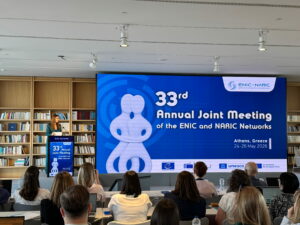
The second day of the 33rd Annual Joint Meeting of the ENIC and NARIC Networks began today with an address by the Minister of Education, Religious Affairs and Sports, Ms Sofia Zacharaki. The meeting is hosted by DOATAP, in cooperation with the European Commission, the Council of Europe and UNESCO.
Ms Zacharaki highlighted that the international academic community is undergoing a period of continuous transformation, as growing student mobility, stronger international cooperation among universities, and the development of new forms of learning and certification continue to reshape the global higher education landscape. In this context, she stressed that “trust, transparency and recognition are becoming fundamental pillars of international cooperation. This is precisely why the work of the ENIC and NARIC Networks is so important for Europe and the international academic community.”
The Meeting began yesterday with the official opening ceremony at the Acropolis Museum, held in the “Dimitrios Pandermalis” Auditorium. The ceremony opened with addresses by the Secretary General for Higher Education at the Ministry of Education, Religious Affairs and Sports, Professor Dimitris Bourantonis, and the President of the Board of Directors of DOATAP, Professor Orestis Kalogirou.
Professor Bourantonis referred to the broader policy of internationalisation and global engagement that the Greek Government has pursued for Greek universities in recent years. He underlined that this policy is also reflected in the major reform of the academic recognition framework, which has strengthened Greece’s institutional alignment with the principles of the Lisbon Recognition Convention (LRC):
“For Greece, the internationalisation of higher education is not a peripheral objective. It is a central national policy choice and an essential element of our broader strategy to strengthen the quality, international outlook and global competitiveness of Greek universities.”
For his part, the President of the Board of Directors of DOATAP referred to the long-standing institutional development of academic recognition in Greece and to the importance of international cooperation, noting, among other things, that:
“Academic recognition is a right and a public good in education, enabling millions of young people to pursue their studies across borders. As ENIC-NARIC centres, we remain committed to providing fair, transparent, reliable and timely recognition. This is our shared mission.”
The Meeting will continue on 25 and 26 May 2026 at the Stavros Niarchos Foundation Cultural Center (SNFCC). Over the course of the three-day event, 140 participants from 43 countries are taking part in 12 thematic workshops focusing on contemporary challenges in the field of academic recognition. These include the use of Artificial Intelligence in assessment and recognition procedures, the development of a common European framework for the automatic recognition of qualifications, and the creation of an integrated digital recognition ecosystem at European and international level.